
A ritual that eases stress, uplifts the mood, and reconnects the body and mind with the living world.
In an age of burnout, chronic stress and anxiety, many of us are searching for ways to quiet our minds and feel our bodies again. The simple act of slowing down has become a form of resistance.
Against this backdrop, the Japanese practice of shinrin-yoku, or forest bathing, offers a profoundly simple antidote: step outside, breathe with the trees, and let nature recalibrate what modern life has unbalanced.
What Is Shinrin-Yoku?
The phrase “Shinrin Yoku” translates literally as “forest bathing” and may seem ancient — yet it was, in fact, a bureaucratic invention. In 1982, Japan’s Ministry of Agriculture, Forestry, and Fisheries coined it as both a health measure and a quiet act of cultural self-repair. The country was deep in its high-tech boom: neon cities, twelve-hour workdays, and the rise of karoshi — death from overwork. People were disconnecting from the natural world that had once shaped their rhythm of life. The government saw the irony: while Japan remained two-thirds covered in forest, its citizens were rarely setting foot among the trees.
Behind the phrase stood a practical vision. Shinrin-yoku formed part of a national Forest Recreation initiative, meant to reconnect city dwellers with nearby green spaces and recast Japan’s forests as a source of public health rather than timber. The plan integrated accessible “recreation forests” into urban life: a preventive medicine approach through landscape design. In the following years, research centres and official Forest Therapy Bases began measuring the physiological effects of immersion in nature — heart rate, cortisol, and immune response.
So shinrin-yoku was introduced as a healing experience — an accessible way to walk, breathe, and let the nervous system recalibrate in the quiet company of trees. Behind the plainness of the term lay something radical: a new public language for an old human need.
Shinrin-Yoku and Japanese Culture
The roots of forest bathing run deep in Japan’s spiritual and aesthetic traditions. Shinto, the country’s indigenous belief system, regards nature as sacred: every river, stone, and tree is inhabited by a spirit (kami). Likewise, the philosophy of wabi-sabi — the Japanese art of finding beauty in imperfection — teaches reverence for simplicity, transience, and the quiet dignity of the incomplete. Its essence lives in every moss-covered path and in the shifting light through cedar leaves.
Within this cultural framework, health is seen not as a clinical state, but as a balance between the body and mind, the self and surroundings. Forest bathing is a living expression of that harmony. It connects modern wellness with ancient awareness — a bridge between ritual and neuroscience, between quiet spirituality and measurable calm.
The Global Rise of Forest Bathing
A Japanese public health experiment has quietly evolved into a global wellness phenomenon, making its way into glossy magazines and Instagram feeds, carrying the promise of “digital detox” and “slow living.” Wellness influencers post forest meditations under the hashtag #forestbathing, and luxury resorts and eco-retreats offer guided immersion walks as part of their mindfulness menus.
Certified “forest therapy” trails now stretch from Tokyo to California and the Scandinavian north. In the U.S. and Europe, shinrin-yoku has entered psychotherapy, corporate wellness programs, and preventive healthcare, sometimes reframed as “nature-based mindfulness.” Academic studies have followed this trend, giving scientific weight to what the senses have always known: that proximity to trees steadies the heart and quiets the mind.
Once seen as a simple form of recreation, forest bathing has grown into a hybrid practice: part ritual, part evidence-based therapy, and a quietly persuasive movement for reconnecting the human body to the living world.
The Science Behind Forest Bathing
Over the past two decades, Japanese and international researchers have documented measurable physiological changes that occur during forest immersion. Meta-analyses and systematic reviews show that participants who spend even a few hours in forest settings experience lower blood pressure, reduced cortisol and adrenaline levels, and higher parasympathetic activity — the body’s “rest and digest” mode.
Part of this effect is biochemical. Forest air is rich in phytoncides: aromatic compounds released by trees to protect themselves from microbes and insects. When inhaled, these natural aerosols appear to enhance human immune function by increasing the activity of natural killer cells and boosting antioxidant capacity.
Yet the impact is also neurological. Surrounded by fractal patterns, dappled light, and soft natural sounds, the brain’s overworked focus circuits quiet down. Thought slows, perception widens, and awareness settles into the body — a gentle return from striving to simply being.
Why Reconnecting with Nature Matters Today
We spend more than 90% of our lives indoors, mediated by screens and artificial light. This disconnection has consequences: rising rates of anxiety, depression, sleep disturbance, and chronic fatigue. Symptoms are sometimes described as “subhealth”, or “the imperfect health” — a transitional state between health and disease.
Ecopsychology suggests that the human mind evolved in constant dialogue with the natural world. When that dialogue breaks, we lose not only external beauty but an internal compass. Reconnecting with nature is not nostalgia — it’s a recalibration of the nervous system, a recovery of sensory intelligence. As studies increasingly show, even short exposure to green environments can restore emotional balance and build resilience to stress.
How to Practice Shinrin-Yoku
You don’t need a Japanese cedar forest to begin. The essence of forest bathing lies in slowing down and opening your senses.
- Choose your place. A park, woodland, or even a quiet botanical garden will do — anywhere you can be surrounded by living greenery.
- Leave your phone behind. The point is to shift from digital to sensory attention.
- Walk slowly. There is no destination; notice textures, sounds, and the rhythm of your breath.
- Engage your senses. Touch leaves, listen to birds, smell the air, watch the play of light.
- Pause and rest. Sit under a tree. Let your gaze soften. Allow the mind to settle naturally.
Urban dwellers can adapt the practice: spend lunch breaks under trees, walk through green corridors, keep plants by your workspace, or open windows to fresh air and natural light. What matters is presence — not location.
How to Start Your Own Forest Bathing Ritual
Try this short sequence next time you step into nature:
- Arrive. Take three slow breaths and feel your feet on the ground.
- Sense. Notice five things you can see, four you can hear, three you can touch, two you can smell, and one you can taste.
- Settle. Let go of the need to analyse. Just be here.
- Reflect. Before you leave, take a moment to thank the space and yourself silently.
Shinrin-yoku is not an escape from life, but a return to it: an invitation to remember that the same calm pulse that moves through the forest also moves through us.
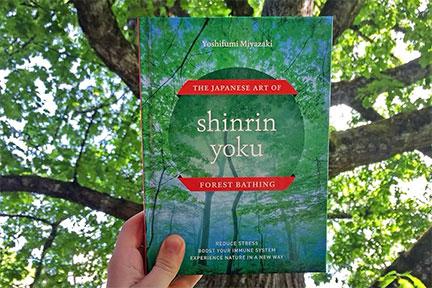
Image: The cover of The Japanese Art of Shinrin-Yoku by Yoshifumi Miyazaki — a guide to forest bathing and reconnecting with nature. Source: Amazon