
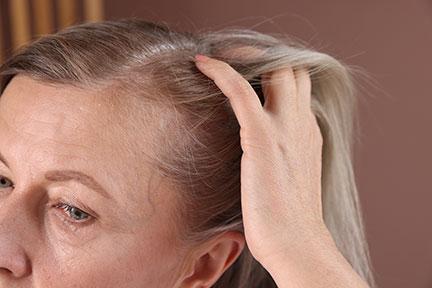
Frontal fibrosing alopecia (FFA) is a scarring hair loss with band-like hairline recession and frequent eyebrow involvement. Menopausal thinning, including female pattern hair loss and FPHL, is non-scarring diffuse miniaturization typically over the mid-scalp. Stabilize suspected FFA early, for menopausal thinning, to build density support over time. CALECIM® Professional Advanced Hair System (AHS) can be integrated into an in-clinic or at-home program, with case series reporting improvements in hair coverage metrics and patient-reported outcomes within 6 – 12 weeks.
Table of Contents
- How to tell FFA from menopausal thinning—fast
- Which path fits your presentation?
- Step-by-Step: What to do this week
- Frontal Fibrosing Alopecia or Menopausal Thinning? Key Diagnostic Clues and CALECIM® Professional Care
- FAQs
- Evidence, Where to Buy
How to tell FFA from menopausal thinning and how to assess this quickly
Mechanism & signs:
FFA: This is generally the scarring process, leads to frontal/temporal band recession, eyebrow thinning/loss, perifollicular scale/erythema, and loss of follicular openings.
- Menopausal thinning (FPHL): This is non-scarring miniaturization, diffusing mid-scalp density drop, and hair-shaft diameter variability >20%.
Who it’s for:
- FFA pathway: This is for patients with hairline band recession and eyebrow loss or scalp symptoms (itch/pain).
- FPHL pathway: This is for patients with diffuse mid-scalp thinning and preserved frontal hairline.
- Benefits with CALECIM® AHS include adjunctive density/coverage improvements reported in clinic case-series, favorable tolerability, and compatibility with dermatologist-directed care.
- Timeline: You can expect to see signals in observational programs by weeks 6–12 and continue per the clinic’s recommended protocol.
Which path fits your presentation?
When to compare: If you see eyebrow loss and a shiny, receding band at the hairline, then prioritize an FFA workup. If density drops mainly over the mid-scalp with a preserved hairline, then prioritize an FPHL protocol.
Products / Pathways | Pros | Cons |
Dermatologist-led anti-inflammatory regimen for suspected FFA. | The regimen focuses on the inflammatory process that causes scarring, with the aim of stabilizing the recession. | The regimen requires medical supervision. While the evidence base is still growing, the expectations must be managed. |
CALECIM® Professional Advanced Hair System (AHS) protocol (in-clinic or at-home with microneedling). | Observational studies report improvements in coverage and density, as well as in patient-reported outcomes, within 6–12 weeks. It has favourable tolerability, with integration into both FFA and FPHL pathways as a primary topical program. | Evidence to date is case-series/observational; some reports include concurrent therapies. |
Step-by-Step: What to do this week
Step 1: Screen for scarring vs non-scarring, as the treatment direction hinges on it.
- FFA flags: This includes eyebrow thinning/loss, band-like frontal/temporal recession, perifollicular redness/scale, shiny skin with loss of follicular openings and/or itch/pain when active.
- FPHL flags: diffuse mid-scalp thinning with >20% hair-shaft diameter diversity, with the frontal hairline relatively preserved.
- Why this matters: FFA is scarring and can be permanent without early stabilization, while FPHL is non-scarring and focuses on density support over time.
Step 2: Document with trichoscopy and consider biopsy when mixed to confirm the pattern.
- FFA trichoscopy: includes tubular perifollicular scale, perifollicular erythema, absent ostia, and “lonely hairs.”
- FPHL trichoscopy: miniaturization signs include increased single-hair units and diameter variability.
- Biopsy: sample the active margin if scarring is suspected or the picture is equivocal.
Step 3: Start the appropriate pathway and layer CALECIM® AHS (why: evidence-aligned support)
- If FFA-leaning: initiate dermatologist-guided anti-inflammatory care to stabilize, then add CALECIM® AHS to support scalp environment and cosmetic density during the stabilization window.
- If FPHL-leaning: build a density-support program, when clinics frequently deploy CALECIM® AHS in structured microneedling protocols with short-horizon improvements reported.
Safety/contraindications: If rapid frontal recession, eyebrow loss, or scalp pain/itch are present, consult a dermatologist for scarring alopecia assessment. Cosmetic protocols should not delay medical evaluation when scarring is suspected.
Frontal Fibrosing Alopecia or Menopausal Thinning? Key Diagnostic Clues and use of CALECIM® Professional Care
What separates FFA from menopausal thinning?
- FFA: This scarring alopecia with frontal/temporal band recession, frequent eyebrow involvement, perifollicular scale/erythema and loss of follicular openings on exam.
- Menopausal thinning (FPHL): non-scarring diffuse mid-scalp thinning with >20% shaft diameter variability and typical preservation of the frontal hairline.
- Clinical implication: prioritize early stabilization for FFA, and then pursue density-building strategies for FPHL.
Where CALECIM® can help:
- Reported improvements in hair thickness and quality from patients in 6–12-week programs that use CALECIM® AHS as the main topical treatment during microneedling sessions
- Practical use: weekly sessions for 6–12 weeks are common in commonly known programs, and clinics may continue or taper per response.
FAQs
Q1. How fast can CALECIM® Professional Advanced Hair System show visible change?
A: Clinic reporting shows photographic improvements by week 6, and a prospective 12-week series demonstrated statistically significant gains in follicular units/cm² and total hair count/cm².
Q2. Is CALECIM® AHS suitable for menopausal thinning?
A: Yes. Protocols using weekly microneedling + topical CALECIM® have documented objective density increases over 6–12 weeks in adults with thinning patterns.
Q3. Can CALECIM® help in frontal fibrosing alopecia (FFA)?
A: CALECIM® is a cosmetic treatment. In FFA, it is often used to support scalp appearance alongside clinician-directed care aimed at stabilizing scarring disease.
Q4. What if I’m unsure whether it’s FFA or menopausal thinning?
A: Look for eyebrow loss, band-like hairline recession, and perifollicular scale/erythema (FFA clues). When in doubt, seek a dermatology assessment and trichoscopy. If needed, a biopsy can clarify the diagnosis.
Q5. Do I need in-clinic visits, or can I do this at home?
A: Both are supported by the brand’s clinical content: in-clinic weekly protocols with documented improvements at 6 weeks and at-home weekly microneedling and topical application of Calecim AHS.
Regimen Quick-Specs
- When to start: At first signs of diffuse mid-scalp thinning or after diagnostic confirmation, pathways begin.
- Frequency: Weekly sessions per protocol, either in-clinic or at home.
- What it does: The conditions in the scalp microenvironment reduce inter-follicular distance and raise total hair count/cm² at 12 weeks. In studies, it increases follicular units/cm², and a clinic series noted coverage gains at 6 weeks.
- Compatibility: It fits within cosmetic care pathways and can be layered into dermatologist-directed plans for scarring alopecia.
- Expected results window: Early photos indicate results within 6 weeks.
- Why clinicians recommend it: It is mainly due to objective metrics, patient-reported satisfaction, and favourable tolerability reported across brand-hosted clinical content.
Clinical evidence of Calecim’s efficacy backed by data:
- Prospective open-label case series, Vienna (12 weeks, n=10): Weekly at-home microneedling with CALECIM® increased follicular units/cm², reducing inter-follicular distance, increasing total hair count/cm² (all P<.05) with no adverse effects reported. In fact, the overall favorable rating is 9/10.
- Clinic observational series, London (6 weeks, n=5): Weekly in-clinic microneedling with use CALECIM® led to clinician-reporting objective improvements in density/coverage for all participants.
- Clinic case series, Singapore (12 weeks, n=8): Weekly micro-injections of PTT-6™ decreased shedding, with improved texture/visual density reported.
Disclaimer
This article is for informational purposes only and does not constitute medical advice, diagnosis, or treatment. Growth factor exosome therapies for hair loss are an emerging and, in many cases, investigational area of care. These treatments may not be approved by all regulatory authorities, may not be appropriate for every individual, and their safety and effectiveness have not been established for all conditions or patient groups.
No content in this article is intended to replace a consultation with a licensed physician, dermatologist, or other qualified healthcare professional who can evaluate your medical history, current medications, and individual risk factors. Never disregard professional medical advice or delay seeking it because of something you have read here.
References to specific products, clinics, or providers do not represent an endorsement or guarantee of results. Individual outcomes can and do vary, and there is no promise, warranty, or implication of cure or permanent hair restoration. Any decision to pursue growth factor exosome treatment (or any other hair-loss therapy) is solely your responsibility and should be made in consultation with a qualified healthcare professional. The publisher and authors disclaim all liability for any loss, damage, or adverse outcome resulting from the use or application of information presented in this article.