

This article is for general information only and does not replace medical advice. Always talk with a healthcare provider about your or your loved one’s treatment plan.
For many older adults living with asthma or COPD, inhalers are part of everyday life. A couple of puffs in the morning, a rescue dose before a walk, maybe an extra treatment on a “bad breathing day” – this routine becomes familiar over time. Yet there are moments when that familiar inhaler no longer seems to give enough relief, or when using it correctly becomes harder than it used to be. Family members may notice missed doses, shaky hands, or confusion around how to use the device, and they start to wonder what other options might exist.
Inhalers vs. Nebulizers: Understanding the Basics
Most seniors with chronic lung disease will come across three main devices: metered-dose inhalers, dry powder inhalers, and nebulizers.
Metered-dose inhalers are the classic “press-and-breathe” type, delivering a measured puff of aerosol medicine that must be timed with a slow, deep inhale, often with the help of a spacer.
Dry powder inhalers instead deliver medicine as a powder that’s inhaled quickly and forcefully, which avoids spray coordination but still requires enough lung strength for a strong breath in - something that can be difficult for some older adults, especially during a flare-up.
Nebulizers take yet another approach. Instead of a quick puff, they turn liquid medication into a fine mist that the person breathes in over several minutes.
The senior sits comfortably, often using a mask or mouthpiece, and breathes normally while the machine runs.
A typical treatment might last five to ten minutes. Some newer, portable mesh nebulizer are designed to deliver this fine mist in a compact, quiet form factor that can be easier to keep nearby at home.
The main difference is not just the medicine itself, but the way the device asks the person to breathe and coordinate their movements. That difference can be crucial for older adults who struggle with the timing and technique of inhalers.
Why Some Seniors Struggle with Inhalers
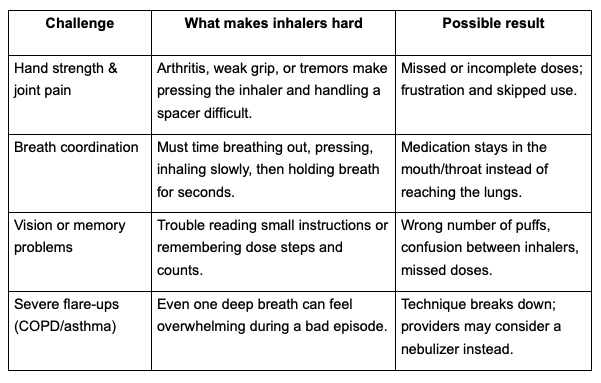
Where Nebulizers Can Fit into a Senior’s Care Plan
Nebulizers are not automatically better than inhalers, and they are not right for everyone.
Doctors usually consider them for seniors who simply cannot use inhalers correctly, even after teaching and adding a spacer, or for those with more severe lung disease, frequent flare-ups, or a mix of fatigue, tremors, and memory issues that make regular inhaler use unreliable.
With a nebulizer, the medication is placed as a liquid into a small cup and turned into a gentle mist that the person breathes in over several minutes.
Because the senior can sit comfortably and breathe more normally while the treatment runs, it often feels less stressful and can make it easier to stick with prescribed therapy.
The decision to use a nebulizer should always be made with a healthcare provider, based on the person’s diagnosis, symptoms, and ability to use different devices safely.
From Tabletop Machines to Portable Mesh Devices
When many people think of nebulizers, they picture large, noisy tabletop machines connected to long tubing.
These compressor nebulizers are still widely used and reliable, but they plug into a wall, aren’t very portable, and the noise can be bothersome for some users.
In recent years, portable mesh nebulizers have become more common. They are small enough to hold in one hand, often run on batteries or USB, and use mesh technology to create a quiet, fine mist.
That makes them easier to use in different rooms at home, at a family member’s house, or while traveling.
A Note on Hypertonic Saline and Mucus Clearance
In addition to bronchodilator or other prescribed medications, some clinicians may also use saline solutions in a nebulizer to help loosen and move mucus.
Hypertonic saline is a sterile salt-water solution that contains a higher concentration of salt than regular (isotonic) saline.
When it is prescribed and used through a nebulizer, this extra salt content can help draw water into the airways, thin thick mucus, and make coughing it out a little easier for some people with chronic lung conditions.
It is very important to emphasize that only solutions specifically labeled and prescribed for nebulizer use should ever be placed in the medication cup.
Families should never use homemade mixtures, regular table salt, or over-the-counter products that are not designed for this purpose.
Ready-to-use hypertonic saline solution for nebulizers can be convenient when a healthcare provider has recommended this type of therapy, but seniors and caregivers should always follow the exact instructions given by their clinician.
Using a Nebulizer Safely at Home
Once a doctor recommends a nebulizer, it’s important to follow the exact schedule and dose they prescribe and not add extra treatments on your own.
After each use, the cup and mouthpiece or mask should be rinsed and left to air-dry as directed, and parts like masks and tubing should be replaced when recommended so the device works properly.
Seniors and caregivers should also watch for side effects such as shakiness, a racing heart, or feeling unusually nervous and contact the healthcare provider if anything feels off, so the medication or dose can be adjusted if needed.
The Bottom Line
For many older adults, inhalers remain the main way to manage asthma or COPD, but when technique problems, physical limits, or severe symptoms get in the way, a nebulizer can be another option for delivering needed medication.
The best device is always the one a senior can use correctly and comfortably, as part of a plan designed with their healthcare team.
Whether that ends up being an inhaler, spacer, tabletop nebulizer, or portable mesh device, the goal is the same: steady, comfortable breathing that supports real daily life and independence.
SeniorLiving.com Respiratory Care Disclaimer
The information provided in this article is for general educational purposes only and is not intended to serve as medical advice, diagnosis, or treatment. SeniorLiving.com does not endorse any specific nebulizer device, manufacturer, medication, or respiratory therapy. Nebulizer use—especially among older adults and individuals with chronic respiratory conditions—should only be incorporated into a Senior’s Respiratory Care Plan under the guidance and supervision of a licensed healthcare professional.
Nebulizers may not be appropriate for all seniors and can pose risks, including improper dosing, medication side effects, infection from incorrect cleaning, or complications related to pre-existing health conditions. Always consult a primary care provider, pulmonologist, respiratory therapist, or other qualified clinician before beginning, modifying, or discontinuing any respiratory treatment.
SeniorLiving.com is not responsible for any adverse outcomes resulting from the use or misuse of a nebulizer or reliance on the information presented in this article. If a senior experiences difficulty breathing, chest pain, sudden changes in respiratory status, or other urgent symptoms, seek emergency medical care immediately.