
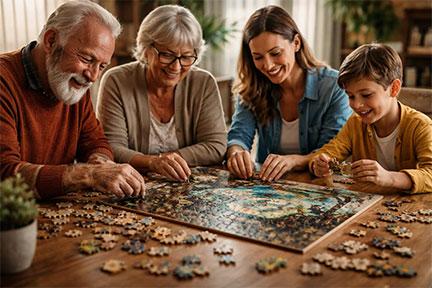
In many homes and senior living communities, meaningful connection often begins with something deceptively simple: a shared challenge laid out on a table. Wooden jigsaw puzzles have long filled that role, and premium designs from nautiluspuzzles.com are recognized for craftsmanship and artistic complexity. Rather than passive entertainment, these wooden jigsaw puzzles create structured collaboration and an environment where different generations can engage, focus, and converse without digital interruption.
In an era defined by digital fragmentation, sustained attention has become scarce. Shared analog experiences, by contrast, have become powerful.
The Cognitive Architecture of Puzzle Engagement
Intergenerational puzzle time is not merely nostalgic. It intersects with measurable cognitive research. A large-scale study involving more than 19,000 participants found that individuals who regularly engaged in puzzles scored higher on reasoning and memory tests later in life. The findings were summarized in a BBC report on puzzle engagement and cognitive performance. Researchers emphasized correlation rather than a guarantee of prevention, but the statistical association is consistent and meaningful.
Further support comes from a peer-reviewed study published in Frontiers in Aging Neuroscience, which found that jigsaw puzzling simultaneously activates multiple cognitive domains, including visuospatial reasoning, episodic memory, and executive functioning. This matters because activities that activate multiple neural systems at once tend to create richer cognitive engagement than passive consumption.
Cognitive diversity within a group strengthens the effect. Seniors often contribute long-term pattern recognition, contextual memory, and patience. Younger participants bring rapid visual scanning and spatial agility. The process becomes collaborative neural engagement rather than solitary recreation.
Wooden jigsaw puzzles for adults are not simply about assembling an image. They are about synchronizing thinking styles across generations, particularly when working on detailed, heirloom-quality designs such as these wooden jigsaw puzzles, which emphasize intricate cuts and artistic depth.
Focus as a Competitive Advantage in a Distracted World
Digital environments reward interruption. Human cognition does not. The American Psychological Association reports that multitasking reduces efficiency and increases cognitive load, particularly when tasks require sustained reasoning.
Complementing this, Stanford researchers found that heavy media multitaskers performed worse on tests of attentional control compared to lighter multitaskers. Their findings are summarized in Stanford’s report on media multitasking.
The implications are strategic. Sustained attention is becoming rare, and rare cognitive abilities often become valuable. Wooden jigsaw puzzles function as an antidote to digital fragmentation. They require singular focus. There are no notifications competing for bandwidth. The pace slows. Attention stabilizes. Conversation emerges organically rather than through forced prompts.
For seniors, this creates cognitive structure. For younger generations accustomed to algorithm-driven stimulation, it provides mental recalibration.
Art as a Conversation Engine
Many wooden puzzle designs are built around fine art, detailed illustration, or nature imagery. That artistic layer adds interpretive depth.
Museums consistently emphasize the cognitive and social value of shared art engagement. Educational frameworks at The Metropolitan Museum of Art’s education resources demonstrate how collaborative art observation strengthens dialogue, interpretation, and critical thinking.
A fine art puzzle becomes more than a task. It becomes a prompt. A grandparent may recognize historical references embedded in a painting. A teenager may focus on composition or color theory. Another participant may interpret symbolic elements. The act of assembling the image becomes a shared interpretive process, particularly when working with intricately illustrated wood puzzles for adults that reward close visual study.
Art creates conversation without forcing it.
Intergenerational Interaction as Social Infrastructure
Modern societies often segment age groups. Schools isolate youth. Workplaces cluster by career stage. Senior communities can become socially insulated.
Yet meaningful cross-generational contact is increasingly recognized as beneficial. The BBC Worklife analysis on bringing generations together explains how sustained engagement across age groups can reduce stereotypes and strengthen social cohesion.
Shared activities provide structure for that engagement. Jigsaw puzzles eliminate competition and create cooperative progress. There is no scoreboard. There is no zero-sum outcome. Success is collective.
That structural neutrality is powerful. It lowers defensiveness and encourages contribution.
Emotional Regulation and Social Bonding
Beyond cognition, shared engagement with puzzles influences emotional tone. Repetitive, focused tasks have been associated with improved coping and emotional regulation habits. While puzzles are not a clinical intervention, structured concentration combined with low-pressure social interaction aligns with widely recommended behavioral strategies for wellbeing.
When generations collaborate toward a shared outcome, subtle psychological shifts occur. Roles become fluid. Authority becomes shared. Conversation becomes lateral rather than hierarchical. The puzzle table becomes neutral ground.
From Hobby to Ritual
Durability shapes tradition. Well-crafted wooden puzzles endure across the years. Premium wooden puzzles are not disposable entertainment. They are physical frameworks for repeated, shared attention over time.
Research from the Greater Good Science Center at UC Berkeley on how rituals support coping and connection suggests that repeated shared activities strengthen social bonds and provide stability during periods of transition.
When families revisit the same wooden puzzle during holidays, gatherings, or milestone events, the object accumulates narrative. It becomes associated with specific conversations, stories, and moments. Ritual builds continuity. Continuity builds identity.
Strategic Implications for Senior Living and Family Spaces
For senior living communities, structured intergenerational programming is often a stated objective.
They require minimal instruction. They accommodate varying cognitive speeds. They create measurable engagement time. They can remain in communal spaces across multiple days, inviting ongoing participation.
For families, they provide an analog counterbalance to digital saturation. Instead of competing for screen time, participants collaborate toward visible progress.
In both contexts, the value proposition is clear: sustained attention, cooperative interaction, artistic engagement, and tactile satisfaction within one structured activity.
Low-Tech, High-Impact Connection
In a hyperconnected yet socially fragmented world, wooden puzzles represent quiet infrastructure. They activate multiple cognitive systems. They encourage sustained focus. They leverage natural materials. They embed artistic interpretation. They provide a cooperative structure across generations.
The mechanics are simple: sort, search, connect. The impact is layered: cognitive stimulation, intergenerational dialogue, emotional regulation, and shared accomplishment. The pieces interlock. Over time, so do the people.