

Choosing between home care and a nursing home depends on your loved one’s health needs, personal preferences, and financial situation. Home care often allows seniors to age in place with personalized support, while nursing homes provide 24/7 medical care for complex conditions. Understanding the cost of home care, available family caregiver support, and nursing home alternatives can help you make a confident, compassionate decision.
Every Canadian family hopes their aging loved ones will enjoy comfort, dignity, and independence as they grow older. But when health begins to decline, the question isn’t just how to care – it’s where. The decision between home care and a nursing home can feel overwhelming, especially when emotions run high and information is scattered.
Whether you’re weighing daily assistance or long-term medical support, this guide breaks down the realities of both paths – so you can choose what truly aligns with your loved one’s needs and values. For those considering personalized support, exploring in home care in Calgary can offer valuable insight into flexible, home-based solutions.
Home Care vs Nursing Home: Key Differences and Considerations
When weighing home care vs nursing home options, it’s essential to look beyond surface-level assumptions. Each model offers distinct advantages depending on your loved one’s health status, lifestyle preferences, and support network. Below, we break down the most critical factors families should evaluate.
Level of Medical Support Required
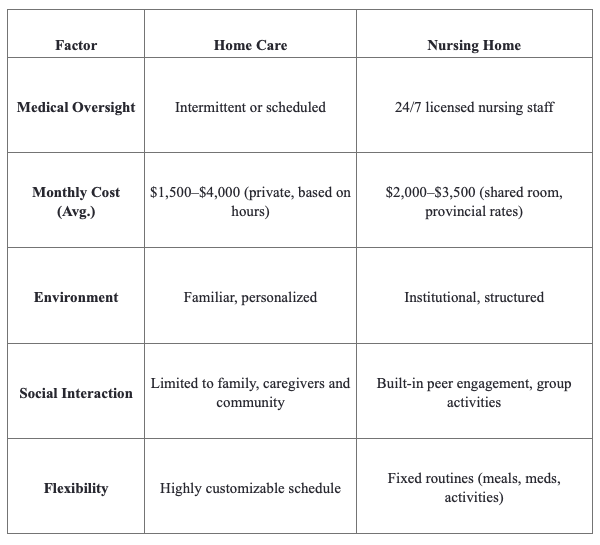
Home care is ideal for seniors who need assistance with daily living but remain relatively stable medically. Services can include help with dressing, bathing, light housekeeping, medication reminders, and companionship. Some private agencies also offer skilled nursing – such as wound care or post-surgical monitoring – but this is typically intermittent, not continuous.
In contrast, nursing homes provide 24/7 access to licensed nurses, physicians, and specialized staff trained in managing complex conditions like late-stage Alzheimer’s, Parkinson’s, or recovery from major surgery. If your loved one experiences frequent falls, requires oxygen therapy, or has unpredictable medical episodes, a facility may offer greater safety.
Cost of Home Care vs Facility-Based Expenses
The cost of home care in Canada varies widely by province, hours needed, and level of care. On average, private home care ranges from $25 to $45 per hour. For 20 hours weekly, that’s roughly $2,000–$3,600 monthly. Government-funded home care may reduce this significantly, though waitlists are common.
Nursing homes, meanwhile, are partially subsidized by provinces but still involve co-payments. In most provinces, basic long-term care costs $2,000–$3,500 per month for a shared room, with private rooms costing more. While this may seem comparable to high-hour home care, nursing home fees cover room, board, meals, and full medical oversight – making them more predictable for high-needs cases.
Emotional Well-being and the Benefits of Staying at Home
One of the strongest arguments for home care lies in emotional health. The benefits of staying at home include reduced anxiety, preserved routines, and a stronger sense of identity and control. Seniors often report feeling “invisible” in facilities, whereas at home, they remain connected to neighbours, pets, and personal belongings that anchor their sense of self.
That said, isolation can be a risk if home care hours are limited and family visits are infrequent. Nursing homes counter this with scheduled social programming – art classes, music therapy, communal dining – which can combat loneliness for those without strong local ties.
Daily Autonomy and Routine Flexibility
At home, your loved one decides when to wake up, what to eat, and how to spend their day. This autonomy supports dignity and mental well-being. Home care adapts to their rhythm – not the other way around.
Nursing homes, by necessity, operate on institutional schedules. Medication rounds, mealtimes, and staff shifts dictate daily flow. While this ensures consistency, it can feel restrictive for independent-minded seniors who value spontaneity.
Maximizing Family Caregiver Support and Exploring Alternatives 
Choosing between home care and a nursing home isn’t just about the senior – it’s also about the well-being of family members who often become primary caregivers. Burnout is real: nearly 60% of Canadian family caregivers report high stress levels, and many delay seeking help until a crisis occurs. The good news? You don’t have to go it alone, and full-time institutional care isn’t your only alternative.
Start by assessing your current support network. Can siblings share responsibilities? Are neighbours or friends willing to check in weekly? Even small acts – like picking up groceries or driving to appointments – free up mental and physical space for primary caregivers.
Next, explore formal family caregiver support programs. Most provinces offer:
- Respite care (temporary professional coverage so you can rest or attend to personal needs)
- Caregiver training workshops (on topics like safe lifting or dementia communication)
- Tax credits (e.g., the Canada Caregiver Credit)
- Local support groups through organizations like the Alzheimer Society or provincial health authorities
If full-time nursing home placement feels premature but home care alone seems insufficient, consider hybrid nursing home alternatives:
- Adult day programs: Offer social engagement, meals, and supervised activities during daytime hours.
- Shared living homes: Small, home-like settings with 24/7 support for 4–6 seniors – more personal than large facilities.
- Coordinated home care teams: Combine personal support workers, nurses, and therapists under one care plan, often through private agencies or community health centres.
These models preserve the benefits of staying at home while adding layers of professional oversight. They’re especially valuable for seniors with moderate cognitive decline who still thrive in familiar surroundings but need more structure than family alone can provide.
Remember: the goal isn’t to “do it all” – it’s to create a sustainable, compassionate care plan that honours your loved one’s dignity and your own limits.
Final Thoughts: Choosing with Compassion and Clarity
Deciding between home care and a nursing home is rarely simple, but it can be deeply meaningful when guided by your loved one’s values, not just their diagnosis. The home care vs nursing home conversation isn’t about choosing the “easiest” path – it’s about finding the option that best supports safety, dignity, and quality of life.
Importantly, this decision doesn’t have to be permanent. Care needs evolve, and so can your plan. Start with honest conversations, involve healthcare professionals, and revisit your choice every few months. What matters most isn’t the setting – it’s that your loved one feels seen, respected, and cared for.
In the end, whether you lean toward in-home support or a long-term care facility, the right choice is the one that aligns with both clinical reality and human connection. And that’s a decision worth making with both your heart and your head.